
The United States Needs Approval Voting


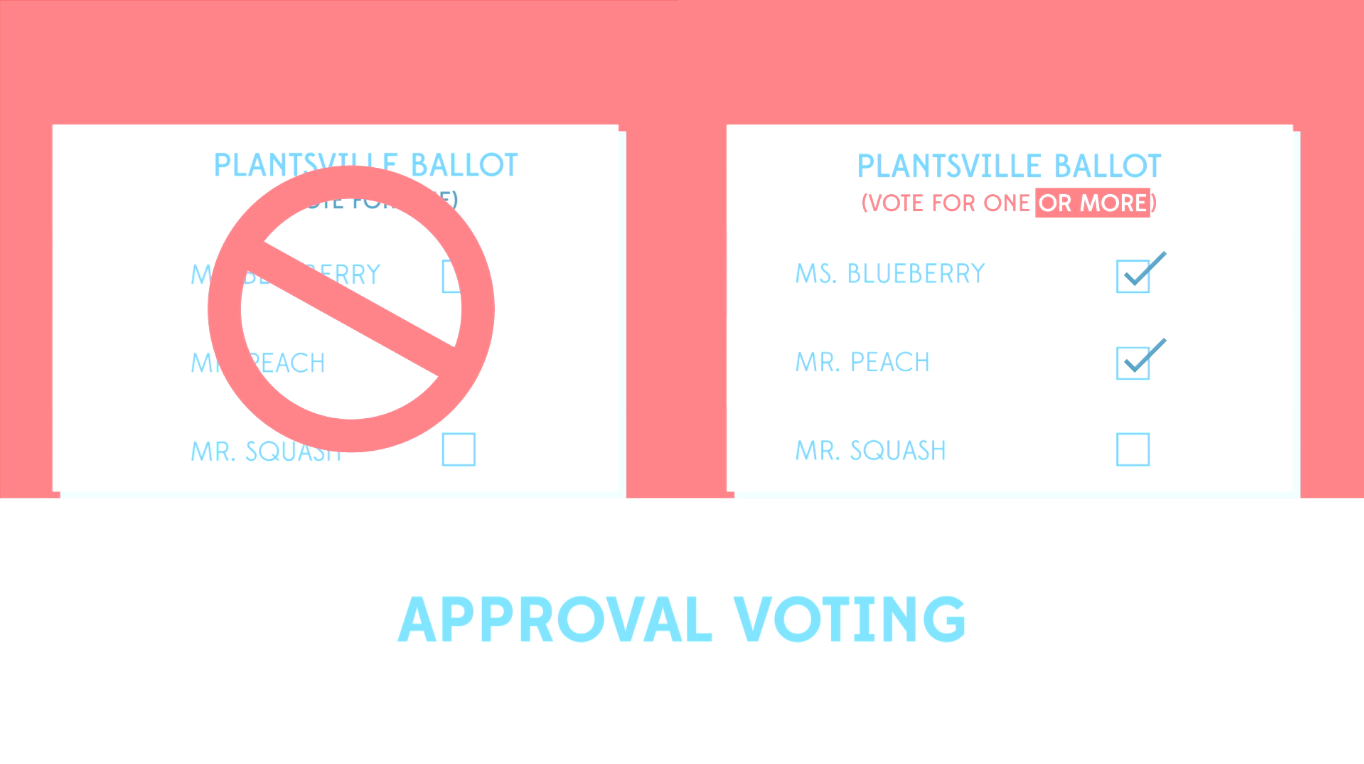








The US government is only as strong as the voting method that elects it. Our current method elects inferior candidates because of vote splitting, and it alienates new ideas because people fear throwing their vote away. Despite this failure, the voting method is unfortunately the last place we look.
No more. Our vote-for-one method is hideously out of date, and it's time the world knows it. The US needs Approval Voting. Simply let people choose as many candidates as they want (no complicated ranking). This puts a grip on vote splitting. And people can fearlessly vote their favorites, every time.
The US deserves a smarter democracy. It deserves Approval Voting. We hope our video shows just how simple and effective Approval Voting is.
28 comments
Gabe Small • about 13 years ago
Very nice work, guys!
Gabe Small • about 13 years ago
I terms of bang for your buck, it's hard to see how any reform could compete with this simple change to our voting system.
Aaron Hamlin • about 13 years ago
Thanks for the support!
William WAUGH • about 13 years ago
I approve this message.
Clay Shentrup • about 13 years ago
By far the most important governmental reform. Whenever we have more than two candidates in a race, there's a good chance for vote splitting, aka the "spoiler effect".
For instance, Maine has an unpopular Republican governor because a moderate liberal independent named Eliot Cutler split the vote with the Democrat.
Whereas in Montana, it looks like the Republican would have beaten the Democrat in the last senate race, were it not for a Libertarian challenger who split the anti-Democrat vote.
So this issue affects both sides of the aisle, and also prevents independent and minor party candidates from seeing an accurate measure of their support in the vote tally.
Approval Voting is by far the simplest easiest solution to this plague.
Gabe Small • about 13 years ago
I noticed that according to the rules, it appears that Approval Voting is the voting method chosen for the Popular Choice Award. :)
We use it every day for things like this without batting an eyelash, and we consider it fair.
In fact, we wouldn't think of holding a vote on something with this many options using First Past the Post. So why do we accept it when there are a small number, like three?
Jameson Quinn • about 13 years ago
Good job!
In fact, this video barely scratches the surface of approval's advantages. In the video, approval voting ends up protecting a popular incumbent from a spoiler. But our current outdated voting system protects unpopular incumbents as a matter of course. As long as they are more popular than their mainstream opponent, they can complacently assume that voters, afraid of the spoiler problem shown in the video, will ignore all "third" candidates. In fact, potential opponents often decide not to run, or drop out of the race, to avoid being spoilers, as happened recently in the Maine senate race; and this anti-democratic choice is in fact the only responsible one under the broken system we have.
Approval voting, by allowing elections with 3 or more candidates to be fair, would improve not just voter choice, but everything about democracy. We'd have a broader, healthier debate, with less zero-sum negativity.
Lomax Abd • about 13 years ago
This video very cleanly and simply points out the simplest, do-no-harm, voting reform. Approval is not the perfect voting system, but considering that it is no-cost and is easy to understand, and when it fails in some way has done no harm, voting systems experts have come to agree that Approval is *the* obvious first improvement. The principle is really of voting independently on all candidates, and that principle can be extended to more sophisticated rating or ranking on ballots. But this is, absolutely, the place to start, and the Center for Election Science has done a fantastic job in making this point. Approval can be combined with other, more established reforms, such as runoff voting, to improve the systems. It's time to start Counting All the Votes, instead of discarding "overvoted" ballots because of an obsolete rule that originated under very different conditions.
Gabe Small • about 13 years ago
Anyone know how the Popular Choice voting works? Has it started yet?
Seth Cohn • about 13 years ago
Approval is the way to go.
Duke Atkins • about 13 years ago
This makes a lot more sense. I like the idea!
Dominic Paris • about 13 years ago
A great simple video. I'd like to see blueberry win if they were using score voting! Great job!
Nate Walker • about 13 years ago
Excellent way to reform the dualism in democracy. I voted for you!
Your ideas are very compatible with the Agenda Setter proposal: http://lookingatdemocracy.org/submissions/14839-agenda-setters
Here's to creative collaboration!
Clay Shentrup • about 13 years ago
I just voted for this video using what appears to be.. APPROVAL VOTING! :D
William WAUGH • about 13 years ago
Gabe S, voting has started. At the upper right of the page about the proposal, you should find a "Vote" button. Pressing it indicates approval.
Jonathon Corbiere • about 13 years ago
This makes a lot of sense.
Ryan Cwiklinski • about 13 years ago
Great video and great concept. It's interesting to see it compared to Ranked Choice Voting: http://lookingatdemocracy.org/submissions/15145-who-s-your-favorite-president-how-ranked-choice-voting-works
Aaron Hamlin • about 13 years ago
Thanks, Ryan. As you can imagine, our focused support for Approval Voting over other methods is quite deliberate. It's hard to imagine a simpler improvement. Plus, you can always vote your favorite in Approval Voting. This is a feature that is simply unavailable to Ranked Choice Voting and other ranked methods. It's remarkable how much gain there is from Approval Voting just by letting voters pick as many candidates as they want.
Laura Krause • about 13 years ago
Excellent! Great message about such an important and long-needed change. I hope enough people hear this and take it to heart, so that our democracy can possibly be salvaged in our lifetime.
Rob Richie • about 13 years ago
Advocates of different methods of voting for single winner offices have a history of rather fractious behavior, but it's improving. Congratulations on that front to those seeking to work more cooperatively.
That said, here's the core difference of opinion. Aaron Hamlin is right that "you can always vote for your favorite in approval voting." That's a good thing, and a good reason to like the system. But problem is that voting for your second favorite can be a problem. Why? Because it counts equally with your favorite and, as a result, can lead to the defeat of your favorite candidate. That means anyone who think their favorite as a chance to win are going to be wary of voting for their second choice -- and we're heading back toward plurality voting dynamics.
Let's be concrete. Among the few examples of contested elections with approval voting are student elections for president the past couple years in Dartmouth. In both of them, the winner earned the approval of less than than 40% of voters. Perhaps that means voters just didn't know much about the candidates. But perhaps it means many didn't want to dilute their vote for their favorite by voting for their second favorite also.
Another example was at U-Colorado this year. In the 2-candidate race for student government president, the result seems to have been 51.9% to 51.6%. The margin was 22 votes, with 246 students apparently voting for both candidates. Did those 246 students really mean to do that? Did they have a difference of opinion that might have tipped the balance if only voting for one ticket?
Ranked choice voting and traditional runoffs both don't have that property, which may explain why advocates of those approaches have been far more successful in having their reforms implemented and used in meaningfully contested elections.
But kudos for having a conversation about reform and it's great to focus on the fact that plurality voting is simply unacceptable -- as this video successful demonstrates.
Finally, let's keep in mind that if we want broader and fairer representation for more of us, we have to have more elections where more than one person wins -- and those winners can represent different opinions and voters. A big focus for some reformers is changing winner-take-all voting rules to fair voting plans like these ones FairVote has drawn for Congress at http://www.fairvoting.us
Aaron Hamlin • about 13 years ago
Correct. Plurality is by far the worst voting method ever invented and needs to be dumped as quickly as possible. Any voting methods expert will correctly pronounce this.
As for alternatives, people have to decide what's important to them. Is it important to always be able to vote your favorite and have all the candidates receive an accurate level of support? And should that be accomplished simply? We think so, which is why we like Approval Voting.
Alternatively, with ranked choice (because only one part of your ballot is observed at any particular time), less preferred choices don't compete with more preferred choices. But that bonus comes at a price. That's because ranking your favorite first can hurt your ballot and cause you a worse outcome. And in unsettling frequency, you don't know if ranking a candidate better can hurt them or help them (a rather precarious state for the voter).
Further, the algorithm to run Ranked Choice is difficult for the average voter to explain, and the results are not quickly understood aside from what the last round looks like. Even more, because ballots get exhausted (you can only rank three anyway, typically), the "majority" only refers to the remaining ballots. This "majority" can turn out to be a fraction of the overall original ballots. The idea of "majority" is much more complicated than one would intuitively think.
So because Approval Voting is so easy to understand, lets you always vote your favorite, gives all candidates an accurate measure of support, and the results are so simple, we go with Approval Voting.
As for elections where more than one wins, some elections are inherently single-winner, which is where Approval Voting is needed. For elections that can be multi-winner, we'll be entering that discussion soon. Just like using Plurality for single-winner elections leads to hideous outcomes, so does using its multi-winner disproportional counterpart.
Gabe Small • about 13 years ago
Personally, I don't really see the problem with people strategically restricting themselves only to their favorite choice in a closely contested election, but the most elegant way to address this, in my opinion, would be to use a Range Voting (aka Score Voting) system that is scaled according to the number of candidates on the ballot.
In other words, if there are only two candidates, you can either Approve or Disapprove each. If there are three candidates, you can score each with 0, 1, or 2. Four candidates: 0, 1, 2, or 3. Etc.
This way, if a voter wants to show a ranking, they have that option. But (and this is critical!) they are not FORCED to rank them.
Edit: This adds complication to a process that should be as simple as possible while still reflecting public opinion, though. And in my opinion, Approval Voting makes big enough strides towards better reflecting public opinion while remaining very simple, so it's the best general purpose improvement.
Gabe Small • about 13 years ago
"Further, the algorithm to run Ranked Choice is difficult for the average voter to explain, and the results are not quickly understood aside from what the last round looks like."
In fact, when asked, many people who participate in Ranked Choice elections think they are submitting a weighted score ballot (similar to what I proposed above).
Eric Sanders • about 13 years ago
Reddit basically uses Approval Voting with an additional "thumbs down."
Clay Shentrup • about 13 years ago
To address Rob Richie's comments:
"anyone who think their favorite as a chance to win are going to be wary of voting for their second choice -- and we're heading back toward plurality voting dynamics."
A) Even if it were true that voters would bullet vote if their favorite candidate had "a chance to win", that wouldn't lead to Plurality Voting—because it is extremely common for multiple candidates to run, many of whom DO NOT have much hope of winning. E.g. Ralph Nader. Any Nader supporter who voted for Gore would want to vote for Gore AND Nader, if we had Approval Voting.
B) Actually, it is NOT true that a voter should bullet vote just because his favorite has "a chance to win". Say the candidates are X, Y and Z, and you would rate them something like X=10, Y=8, Z=0. And say they're all neck-and-neck in the polls. Your best strategy is NOT to bullet vote for X. A better tactic is to vote for X *and* Y. Yes, this may cause Y to win instead of X. But in that case, you lose only 2 points of happiness. Whereas if you cause Y to win instead of Z, then you GAIN 8 points of happiness.
The Dartmouth election appears to have been a huge success. I showed here why Rob Richie's critique of it is flawed, yet he still repeats that critique. :(
http://clayshentrup.blogspot.com/2012/10/rob-richie-misleads-on-approval-voting.html