
Who's Your Favorite President? How Ranked Choice Voting Works.
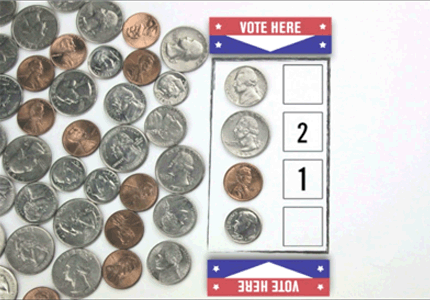


As politics grow ever more polarized in America and legislative political gridlock remains commonplace, it becomes apparent that the fault lies within our current electoral system. Our plurality, winner-take-all system fosters and rewards the sort of behavior that has turned politics into an blood sport rather than the honest, constructive, issue-oriented dialogue our country needs.
Instituting Ranked Choice Voting can fix that. Now is the time for change.
FairVote Minnesota is nonprofit, nonpartisan public interest group public interest group working to enhance democracy through public education and advocacy.
12 comments
Drew Spencer • about 13 years ago
Nice work FairVote Minnesota! With ranked choice voting, voters can really have real choices on the ballot and still know that the winner will be one with majority support. Allowing more voices to participate in a positive way means a better democracy.
William WAUGH • about 13 years ago
In single-winner elections (presidency, Senate), RCV would maintain the two-party system, which we know functions in effect as a one-party system. For those elections, democracy needs a voting system having the advantages of Approval Voting.
Reasoning for why RCV maintains the two-party system: http://www.youtube.com/watch?v=iDzYRDTVRS8
Approval Voting: http://lookingatdemocracy.org/submissions/14935-the-united-states-needs-approval-voting
Drew Spencer • about 13 years ago
Clay, you may want to edit your post. Under your example, the Democrat would win, not the Progressive. What you meant to say was this:
35% Progressive > Democrat > Republican
32% Democrat > Progressive > Republican
33% Republican > Democrat > Progressive
Note that in order for the Republicans to take advantage of what you're talking about, they would have to know that their candidate will come in second but will not win. How they could know that is a bit of a mystery, but probably even if they did they would just campaign harder for their candidate in the hopes he would come in first, and maybe campaign more positively to get more second place votes from the Democrat. The Democrat would do likewise, hoping to beat the Republican in the first tally. The result is better, smarter, and more positive campaigning.
Clay Shentrup • about 13 years ago
Drew,
You're correct. I got the 32% and 33% backwards. Thanks for spotting that. The real numbers from the Burlington election are here:
http://ScoreVoting.net/Burlington.html
"Note that in order for the Republicans to take advantage of what you're talking about, they would have to know that their candidate will come in second but will not win. "
So let's say they don't take advantage of it. Then they get punished for ranking their favorite in first place.
However, I want to be clear that I don't think this makes IRV "a bad system". I think it can be a big improvement over ordinary vote-for-one Plurality Voting. However, it's proponents have a tendency to make misleading positive claims about it, and I wanted to address a couple of those.
Rob Richie • about 13 years ago
Great video by the team at FairVote Minnesota! Fairvote Minnesota has done incredible work, and it's paying off with both Minneapolis and St. Paul holding ranked choice voting elections this November, and important state legislation under consideration.
As to comments by Clay and William, I appreciate the tone of Clay's remarks, but would ask that approval voting advocates take a similar look at their own claims about approval voting.
For instance, approval voting is largely untested in meaningfully contested elections. Among those few examples are student elections for president the past couple years in Dartmouth. In both of them, the winner earned the approval of less than than 40% of voters. What might that tell us?
Another one was at U-Colorado this year. In the 2-candidate race for student government president, the result seems to have been 51.9% to 51.6%. The margin was 22 votes, with 246 students apparently voting for both candidates. Kinda strange, frankly.
In the council election, those same student voters overwhelmingly approved of the same number of candidates as seats, and none of the four winners earned support from half the voters. The losing president's ticket did better, suggest that perhaps that ticket may well have won the presidential race too in a "one person, one vote" election.
In Burlington's 2009 election, any realistic assessment of the rankings and the political dynamic suggests to me that approval voting would have elected the Republican who was the "condorcet loser" among the top three candidates. The only system that would have guaranteed the third-place Democrat's win is a Condorcet system., which has its own political pitfalls. We certainly don't see it as a tragedy that the winner was the candidate who also would have run in a traditional runoff election, defeating the first choice count leader who would have lost in a runoff to either of the other top two candidates.
David Wetzell • about 13 years ago
Larger parties are a result of economies of scale in running for major elections, like the presidency or gubernatorial or senatorial elections. So it seems that we are bound to have a two-party dominated system in the US, since our constitution mandates the use of high value single-winner elections and it'd be very hard to make constitutional changes away from that.
But not all 2-party dominated systems need to act like one-party. The dysfunctions of our two major parties come largely from how our system tilts too easily to effective single-party domination, so both parties have the perverse incentives both to attack the other and to mimic the other on most issues. These dysfunctions are seriously reduced with the use of IRV, largely by how third parties would get to bring up more issues and be important in deciding more elections. This constructive role for third parties, even though it likely wouldn't end two-party domination, would create a greater dynamism about the center that would make it harder for the dominant party to $pin the center.
But if we mixed more American forms of Proportional Representation into our electoral system, via our nat'l and state representative elections, then it'd subvert the tendency for our system to tilt to one-party. This is shown by the example of IL from 1870-1980 when 3-seat quasi-pr for the state representaive elections prevented either major party from dominating the state's politics, as o.w. has tended to happen. And, if the system doesn't tilt to one-party domination then the waning major party won't feel the need to "pragmatically" strongly emulate the waxing major party.
As for approval voting, it's purported advantages over IRV presumes scenarios where 3-way competitive elections are likely. This is not realistic due to the economies of scale in election campaigns. It also relies on abstract models that don't consider how in real life parties re-position themselves to be competitive in elections. IRV is pilloried because it's possible that voters might be coerced to vote strategically, like with Republicans in Burlington VT. But this only happens if a major party refuses to accommodate the center. That happens a lot in our current system, but once the major parties get used to IRV then it'd be a lot less likely.
dlw
Eric Sanders • about 13 years ago
This is cool! I still prefer Approval Voting, though: http://lookingatdemocracy.org/submissions/14935-the-united-states-needs-approval-voting
But glad to have multiple submissions on voting reform-related themes!
David Wetzell • about 13 years ago
Hi Eric S, the most important thing is that there be only one alternative to FPTP (something besides top two primary) at a time in our current fptp system, so they don't divide and conquer us and that we simplify things and keep things cordial as we market the better alternatives to the US.
dlw
Eric Paul Jacobsen • about 13 years ago
I absolutely endorse Instant Runoff Voting, a.k.a. Ranked Choice Voting, but for elections to fill councils and legislatures, it is only the first step. For these elections, we need to combine IRV or RCV with bigger districts, each having about five representatives elected proportionally. This is PROPORTIONAL REPRESENTATION, the ultimate solution to gerrymandering and numerous other weaknesses of our primitive and un-representative electoral system.
I endorse the views of Douglas J. Amy, who has posted clear and detailed discussions of proportional representation that you can easily look up online.
David Wetzell • about 13 years ago
Hi Eric Paul J,
I agree on the need for proportional representation.
I think 3-5 seats for US congressional elections is good
and that for city council or state assembly seats that 3-seat PR is a lot better if a hare quota is used. I also think that if there are only 3 seats and a hare quota that it is of less import whether there is ranking or not.
I am familiar with Douglas Amy's views on PR. Trust me 3-seats + Hare Quota makes for a winning combination if there is also at least one at-large seat or another way to guarantee sufficient hierarchy to get things done.
dlw
Tom Vellenga • about 13 years ago
Good cause, good org., great leader in Jeanne Massey, who rocks...intelligently.
> Trust in the will of all the people...find ways to bring all the people into democracy.
Harlan Johnson • about 13 years ago
If I were a judge, you'd be on my short list. You fit the criteria. Several entries make the point you make. I haven't found another like mine. Look at my submission. "Elections Clarified" https://vimeo.com/64616892 or
http://www.youtube.com/watch?v=yQZSII6C3-A Maybe we can work together some way. I'd love to hear from you.